Introduction
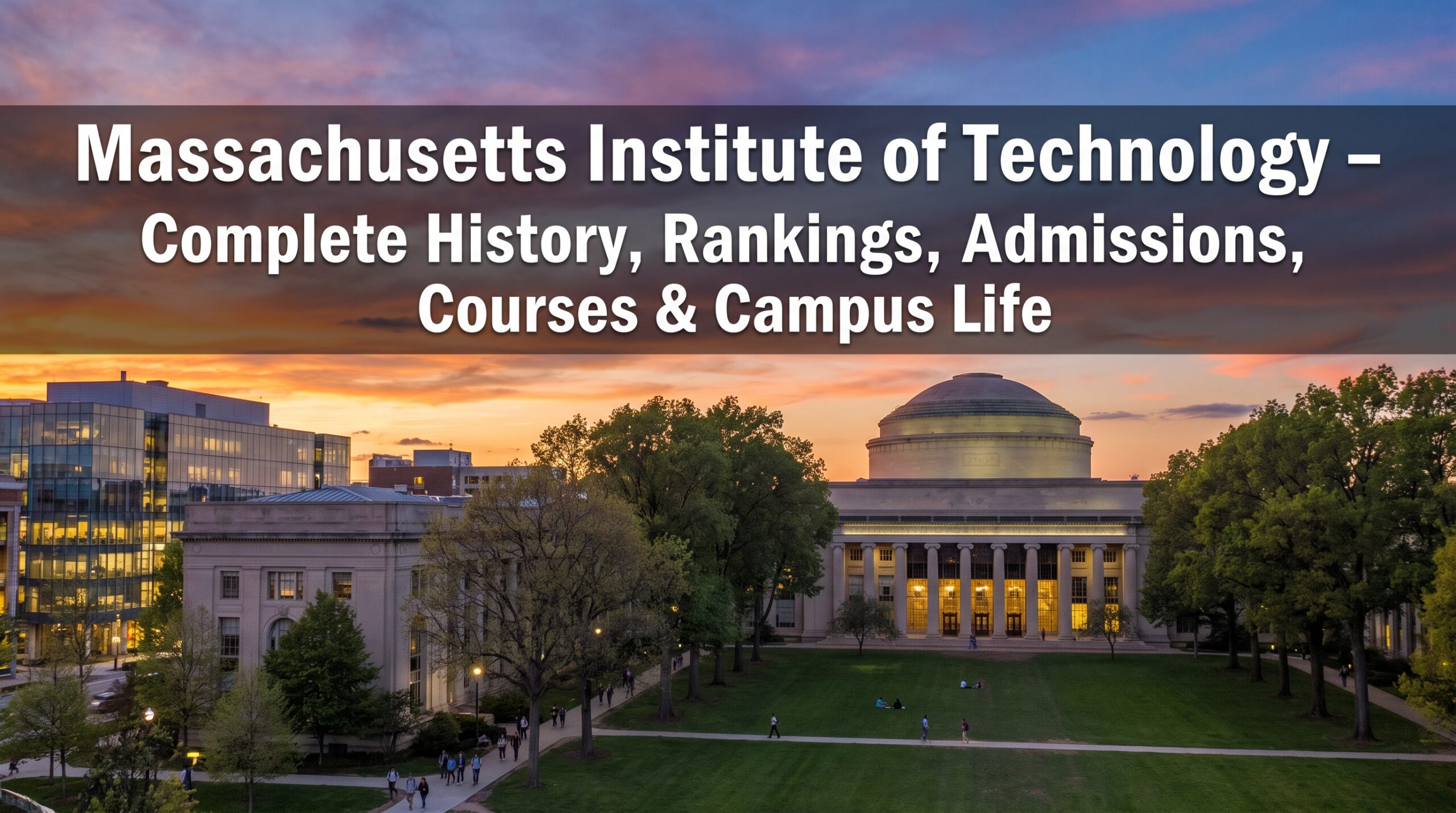
The Massachusetts Institute of Technology (MIT) stands as an unparalleled titan in the global landscape of higher education. Situated on a sprawling 168-acre campus along the Charles River in Cambridge, Massachusetts, MIT is far more than a traditional university; it is an engine of human progress, a crucible for technological revolution, and a sanctuary for the world’s most brilliant, unorthodox minds. For over a century and a half, the Institute has relentlessly pursued its mission to advance knowledge and educate students in science, technology, and other areas of scholarship that will best serve the nation and the world. From the earliest days of industrialization to the modern frontiers of artificial intelligence and quantum computing, MIT has consistently been at the absolute vanguard of human discovery.
As of 2026, MIT continues to dominate the academic sphere, proudly maintaining its position as the number one university in the world according to the QS World University Rankings—a phenomenal distinction it has held for an unprecedented fifteen consecutive years. The Institute operates with an endowment exceeding $27.4 billion, funding cutting-edge research across its six distinct academic schools. Its alumni network reads like a directory of the architects of the modern world, featuring dozens of Nobel laureates, pioneering astronauts, visionary entrepreneurs, and the founders of companies that collectively generate trillions of dollars in annual global revenue. Yet, beneath the intimidating statistics and the towering academic reputation lies a profoundly unique campus culture defined by a fierce commitment to meritocracy, an irreverent sense of humor, and a collaborative spirit encapsulated by its famous motto: Mens et Manus (Mind and Hand).
Founding and Early History
The origins of the Massachusetts Institute of Technology are deeply intertwined with the rapid industrialization of the United States in the mid-19th century. The visionary behind the Institute was William Barton Rogers, a distinguished natural scientist and educator who recognized a glaring deficiency in the American educational system. Rogers believed that classical universities, which focused heavily on theology, classical languages, and abstract philosophy, were failing to equip students with the practical, technical skills required to navigate and lead an increasingly industrialized society. He envisioned a new type of institution—a polytechnic institute that would bridge the gap between theoretical science and practical application.
In 1861, just two days before the start of the American Civil War, the Commonwealth of Massachusetts officially approved Rogers’ charter for the “Massachusetts Institute of Technology and Boston Society of Natural History.” However, the outbreak of the war severely delayed the opening of the school. It was not until 1865 that the first classes were held in a rented space in the Mercantile Building in downtown Boston. The Institute’s early curriculum was revolutionary for its time, emphasizing laboratory instruction over rote memorization—a radical departure from the pedagogical norms of the 1860s. Students were expected to actively participate in experiments, testing hypotheses with their own hands, directly embodying the Mens et Manus philosophy.
The early years were fraught with severe financial instability. The Institute struggled continuously to secure sufficient funding, relying heavily on the Morrill Land-Grant Colleges Act to stay afloat. During the late 19th century, MIT was frequently on the brink of bankruptcy. There were multiple, highly publicized proposals to merge the struggling Institute with neighboring Harvard University. However, the MIT alumni and student body vehemently opposed these mergers, fiercely defending their distinct institutional identity and practical curriculum. Through sheer perseverance, private donations, and a growing recognition of the value of engineering education, MIT survived its precarious infancy and began to establish itself as a premier technical school.
Relocation to Cambridge and The New Technology
By the dawn of the 20th century, MIT had entirely outgrown its cramped, fragmented facilities in the Back Bay neighborhood of Boston. The student body was expanding rapidly, and the cramped laboratories were woefully inadequate for the ambitious research projects being undertaken by the faculty. Under the transformative leadership of President Richard Maclaurin, the Institute embarked on a massive campaign to secure a new, permanent home. Through the incredibly generous, initially anonymous donations of industrialist George Eastman (the founder of Eastman Kodak), famously known during the fundraising campaign only as “Mr. Smith,” MIT purchased a large tract of reclaimed swampland across the Charles River in Cambridge.
In 1916, the Institute officially moved to its new Cambridge campus. The architectural design, envisioned by William Welles Bosworth, was a stunning departure from the collegiate gothic style prevalent at other Ivy League institutions. Bosworth designed a monumental, neoclassical complex of interconnected buildings surrounding a grand central court (Killian Court), crowned by the majestic Great Dome. This interconnected design was not merely aesthetic; it was highly intentional, designed to foster spontaneous interdisciplinary collaboration by forcing students and faculty from different departments to cross paths in the sprawling hallways, most notably the famous Infinite Corridor. The move to Cambridge marked the birth of “The New Technology,” establishing the physical and philosophical foundation for the modern MIT.
World War II and The Cold War Transformation
The trajectory of the Massachusetts Institute of Technology was fundamentally altered by the outbreak of World War II. Under the guidance of Vannevar Bush, a former MIT vice president who became the head of the federal Office of Scientific Research and Development, the U.S. government began funneling unprecedented amounts of funding into academic research. MIT became the absolute epicenter of the nation’s wartime technological efforts. The most significant development was the establishment of the Radiation Laboratory (the “Rad Lab”), which was tasked with developing and perfecting microwave radar technology. The Rad Lab grew to employ thousands of scientists and engineers, and its innovations were deemed just as critical to the Allied victory as the Manhattan Project.
Following the war, the relationship between MIT and the federal government, particularly the Department of Defense, remained incredibly strong. During the Cold War, MIT was a primary beneficiary of defense spending, leading to a massive expansion of its research capabilities. The Institute established the Lincoln Laboratory, a federally funded research and development center focused on national security, air defense, and advanced electronics. During this era, MIT transformed from an elite regional engineering school into a colossal, globally dominant research university. The influx of government funding allowed the Institute to attract the brightest scientific minds from around the world, establishing a culture of high-stakes, big-budget “megascience.”
The Digital Revolution and Modern Era
As the mid-20th century progressed, MIT transitioned from dominating the physical sciences to pioneering the digital revolution. The Institute’s laboratories were the birthplace of numerous foundational technologies that define the modern computing era. In the 1950s and 60s, MIT researchers developed Whirlwind, one of the first digital computers to use magnetic core memory. Shortly thereafter, Project MAC (Mathematics and Computation) was launched, laying the groundwork for time-sharing operating systems and fundamentally shaping the trajectory of artificial intelligence research under luminaries like Marvin Minsky and John McCarthy.
MIT was also intrinsically involved in the creation of the internet. The Institute was one of the original nodes on the ARPANET, and its computer scientists made vital contributions to networking protocols. Furthermore, the modern “hacker” culture—characterized by a playful, highly technical, and anti-authoritarian approach to computing and engineering—originated within the halls of MIT’s Tech Model Railroad Club and the Artificial Intelligence Laboratory. Moving into the 21st century, MIT continued to disrupt the academic landscape. In 2001, the Institute launched MIT OpenCourseWare (OCW), an unprecedented initiative to publish virtually all of its course content online for free. This was followed by the creation of edX in partnership with Harvard, democratizing access to elite education on a global scale.
Academic Structure and Schools
Unlike many traditional universities that boast dozens of disparate colleges, MIT maintains a highly concentrated, rigorous academic structure. The Institute is organized into five primary academic schools and one groundbreaking college, encompassing over 30 distinct academic departments and programs. This streamlined structure is designed to minimize bureaucratic silos and maximize interdisciplinary cross-pollination. The lines between departments are intentionally porous, allowing students to seamlessly pursue double majors or collaborate on research that bridges multiple fields.
| School / College | Year Established | Focus Areas & Key Departments |
|---|---|---|
| School of Architecture and Planning (SA+P) | 1932 | Architecture, Urban Studies and Planning, Media Arts and Sciences (Media Lab), Real Estate. |
| School of Engineering | 1932 | Aeronautics, Biological Engineering, Chemical, Civil, Mechanical, Materials Science. |
| School of Humanities, Arts, and Social Sciences (SHASS) | 1950 | Economics, Political Science, Linguistics, Literature, Global Languages, Music and Theater. |
| Sloan School of Management | 1952 | Management, Finance, Operations Research, Innovation and Entrepreneurship. |
| School of Science | 1932 | Biology, Brain and Cognitive Sciences, Chemistry, Earth/Atmospheric Sciences, Mathematics, Physics. |
| Schwarzman College of Computing | 2019 | Electrical Engineering and Computer Science (EECS), AI, Data Science, Social Impact of Technology. |
Schwarzman College of Computing
The establishment of the MIT Stephen A. Schwarzman College of Computing in 2019 represented the most significant structural change to the Institute since the 1950s. Backed by a $350 million foundational gift from Blackstone CEO Stephen A. Schwarzman, the College was created to address the pervasive, transformative nature of artificial intelligence and computing across all academic disciplines. Rather than isolating computer science in a single department, the College operates as an connective tissue, linking the massive Electrical Engineering and Computer Science (EECS) department with every other school at MIT.
The creation of the College was an acknowledgment that computing is no longer a standalone discipline, but a fundamental tool—much like mathematics or writing—that must be integrated into biology, economics, architecture, and the humanities. The College also places a massive emphasis on the ethical implications of technology, ensuring that the next generation of technologists are not only highly capable coders, but thoughtful leaders who understand the societal impact of the algorithms and systems they create.
Undergraduate Admissions and Selection Process
Gaining admission to the undergraduate program at the Massachusetts Institute of Technology is one of the most statistically challenging feats in global higher education. For the classes entering in the mid-2020s, including the Class of 2028 and 2029, the overall acceptance rate hovered intensely around the 4.0% to 4.5% mark. MIT evaluates tens of thousands of applications annually from incredibly qualified students worldwide, ultimately extending offers to barely over a thousand individuals. The admissions process is notoriously grueling and distinct from many other elite institutions, notably because MIT does not use the Common Application, opting instead for its own highly specific application portal designed to gauge a student’s true fit for the Institute’s unique culture.
The MIT admissions committee practices a deeply holistic review process, but academic excellence—particularly in advanced mathematics and the physical sciences—is an absolute, non-negotiable prerequisite. However, perfect grades and test scores are merely the baseline. MIT aggressively seeks students who demonstrate extreme resilience, a collaborative spirit, and a history of taking initiative. The admissions officers look for “makers” and “doers”—students who have built robots in their garages, founded community science programs, or engaged in high-level independent research. Furthermore, following a brief pandemic-era pause, MIT became one of the first elite universities to permanently reinstate its standardized testing requirement (SAT or ACT), arguing that rigorous quantitative testing remains the most equitable predictor of a student’s ability to survive the punishing mathematical curriculum required of all incoming freshmen.
Graduate Admissions and Programs
While the undergraduate population at MIT is highly visible, the Institute is fundamentally a graduate-centric research university. Graduate students outnumber undergraduates by a significant margin. The graduate admissions process is entirely decentralized; there is no central graduate admissions office. Instead, prospective master’s and doctoral candidates apply directly to individual academic departments. This hyper-focused selection process ensures that applicants are evaluated directly by the faculty members they will eventually be conducting research alongside.
Selectivity at the graduate level varies significantly by department but is universally competitive, often mirroring or exceeding the strictness of undergraduate admissions. Programs such as the Ph.D. in Computer Science, the Master of Finance at the Sloan School, and the various doctoral tracks in the School of Engineering accept only a tiny fraction of applicants. Graduate students are fully integrated into the vast laboratory ecosystem of MIT, often serving as the primary drivers of the Institute’s most groundbreaking research, authoring highly cited academic papers, and pioneering startup companies long before they defend their dissertations.
World Rankings and Global Reputation
The global academic reputation of the Massachusetts Institute of Technology is completely peerless, particularly in the realms of science, engineering, and technology. Institutional ranking organizations consistently place MIT at the absolute summit of higher education. In the 2026/2027 edition of the highly respected QS World University Rankings, MIT secured the number one overall position globally, a staggering achievement marking its 15th consecutive year at the very top of the list. The Institute consistently scores a perfect 100 in academic reputation, employer reputation, and faculty-to-student ratio metrics.
| Ranking Organization (2026/2027 Data) | Global Rank | Key Top-Ranked Subject Areas |
|---|---|---|
| QS World University Rankings | #1 | Computer Science, Mechanical Engineering, Chemistry, Linguistics, AI. |
| U.S. News & World Report (Global) | #2 | Physics, Mathematics, Biology, Economics, Business. |
| Times Higher Education (THE) | #2 / #3 | Engineering, Physical Sciences, Life Sciences, Technology. |
| Academic Ranking of World Universities (ARWU) | #3 | Electrical Engineering, Computer Science, Economics. |
Core Curriculum and General Institute Requirements (GIRs)
The defining feature of an undergraduate education at MIT is its famously punishing core curriculum, formally known as the General Institute Requirements (GIRs). Unlike many liberal arts colleges that offer highly flexible, open curricula, MIT mandates that every single undergraduate—regardless of whether they are majoring in comparative literature, economics, or aerospace engineering—must conquer a rigorous, heavily quantitative scientific core. The underlying philosophy is that every MIT graduate must possess a profound, fundamental understanding of the physical world and the mathematical language used to describe it.
The Science Core of the GIRs consists of six specific foundational classes: two semesters of advanced calculus (typically 18.01 and 18.02), two semesters of calculus-based physics (8.01 and 8.02), one semester of chemistry (5.11 or equivalent), and one semester of biology (7.01). These classes are notorious for their difficulty and heavy workload, famously described by generations of students as “drinking from a firehose.” To mitigate the intense pressure of the transition to MIT, freshmen are graded on a Pass/No Record basis for their first semester, allowing them to acclimate to the sheer volume of work without permanently damaging their academic transcripts.
Beyond the Science Core, the GIRs mandate a robust Humanities, Arts, and Social Sciences (HASS) requirement. Students must complete eight HASS subjects across different disciplines, ensuring that MIT engineers and scientists possess strong communication skills and a deep understanding of the societal contexts in which their technologies will be deployed. Finally, MIT maintains a highly unique Physical Education and Wellness requirement, which explicitly includes a mandatory Swim Test; students must prove they can swim 100 yards continuously to graduate, a historic tradition dating back to the Institute’s belief in well-rounded physical capability.
Notable Academic Courses and Majors (The Numbering System)
At MIT, academic majors, departments, and individual classes are rarely referred to by their actual names; instead, they are almost exclusively identified by a complex, historical numbering system. For outsiders, eavesdropping on an MIT conversation can feel like listening to code. A student doesn’t say, “I’m a computer science major taking introduction to solid-state chemistry;” they say, “I’m Course 6, and I’m taking 3.091.” This deeply ingrained numerical culture is a defining quirk of the Institute.
The most popular and heavily populated major at the Institute is Course 6 (Electrical Engineering and Computer Science), which accounts for a massive percentage of the undergraduate population. Other historically dominant majors include Course 2 (Mechanical Engineering), Course 8 (Physics), Course 18 (Mathematics), and Course 9 (Brain and Cognitive Sciences). The Institute also offers highly specialized, interdisciplinary majors such as Course 6-14 (Computer Science, Economics, and Data Science) and Course 20 (Biological Engineering), which reflect the rapid evolution of modern scientific industries.
MIT also embraces an irreverent approach to learning. One of the most famous unofficial academic pathways is the “Pirate Certificate.” If a student successfully completes specific physical education courses—namely Archery, Fencing, Pistol (or Rifle), and Sailing—the physical education department officially awards them a physical Pirate Certificate printed on faux-parchment. It is a brilliant example of the Institute’s willingness to balance its punishing academic rigor with genuine, nerd-culture humor.
Research Laboratories and Centers
The true beating heart of MIT is its sprawling network of massive, highly funded research laboratories and interdisciplinary centers. These facilities are not merely academic training grounds; they are the literal engines of global technological progress. The largest and most famous of these is the Computer Science and Artificial Intelligence Laboratory (CSAIL). Housed in the visually striking Stata Center, CSAIL is a massive hub where hundreds of principal investigators, postdocs, and graduate students work on the bleeding edge of robotics, machine learning, cryptography, and quantum computing. Historically, CSAIL and its predecessors were instrumental in the development of the World Wide Web, public-key cryptography (RSA), and the earliest chess-playing algorithms.
Equally renowned is the MIT Media Lab, an incredibly unique, anti-disciplinary research center focused on the convergence of design, multimedia, and technology. The Media Lab operates without traditional academic boundaries, hosting research groups that explore everything from wearable computing and tangible interfaces to the future of musical expression and neurobiology. Researchers at the Media Lab are famously encouraged to “demo or die,” prioritizing the creation of working, tangible prototypes over purely theoretical academic papers. Other monumental research pillars include the Lincoln Laboratory (focused on national security and advanced defense electronics), the Whitehead Institute for Biomedical Research, and the Broad Institute (a massive genomic research center operated in partnership with Harvard).
Campus Architecture and Landmarks
The MIT campus in Cambridge is a fascinating, eclectic architectural timeline of the 20th and 21st centuries. The core of the campus, known as the Main Group, was designed by William Welles Bosworth in 1916. These interconnected, neoclassical buildings feature massive limestone columns, soaring pavilions, and the iconic Great Dome (Building 10), which overlooks Killian Court. The Main Group is tied together by the Infinite Corridor, a massive, straight hallway running a sixth of a mile through the center of the campus. Twice a year, in a phenomenon known as “MIThenge,” the setting sun aligns perfectly with the length of the Infinite Corridor, drawing crowds of students to witness the blinding corridor of light.
Moving away from the Main Group, the architecture becomes radically modern and experimental. The Ray and Maria Stata Center (Building 32), designed by the legendary Frank Gehry, is a highly controversial, deconstructivist masterpiece characterized by tilting towers, wildly angled walls, and bright, clashing colors. It was designed to reflect the chaotic, creative energy of the computer scientists who work inside it. Other architectural landmarks include the Kresge Auditorium and MIT Chapel, both designed by mid-century modern master Eero Saarinen; the Green Building (Building 54), an imposing concrete tower designed by I.M. Pei that houses the Earth Sciences department; and Simmons Hall, a striking, sponge-like undergraduate dormitory designed by Steven Holl.
Campus Life and Residential System
The residential culture at MIT is profoundly unique and fiercely guarded by the student body. Unlike many universities where dormitories are simply places to sleep, MIT’s residences possess intense, highly distinct subcultures, and students actively choose where they want to live through a complex housing selection process during their freshman orientation period. The campus is broadly divided into East Campus and West Campus, a geographical divide that also historically represents a massive cultural divide.
East Campus dormitories (such as the creatively chaotic East Campus residence and the historic Senior House, though its status has fluctuated over the years) are legendary for their counter-cultural, DIY, highly permissive environments where students frequently build massive wooden roller coasters in the courtyard, dye their hair bright colors, and modify their rooms with power tools. Conversely, West Campus dormitories (like Maseeh Hall, Baker House, and McCormick Hall) generally offer a more traditional, slightly quieter collegiate experience. Additionally, a massive percentage of MIT undergraduates choose to live across the river in Boston in Fraternities, Sororities, and Independent Living Groups (FSILGs). These independent houses provide a tight-knit family atmosphere and heavily emphasize student self-governance and alumni networking.
MIT Culture, Hacking, and Traditions
To understand MIT is to understand its unique, irreverent culture, which heavily values technical ingenuity, practical jokes, and a healthy skepticism of authority. The most famous manifestation of this culture is “Hacking.” In the MIT lexicon, a hack is a clever, benign, and highly ethical prank that demonstrates incredible engineering skill and physical daring. Hacks are executed anonymously under the cover of darkness. The most legendary hack in the Institute’s history occurred in 1994, when students secretly assembled a fully realistic, life-sized replica of a Cambridge police car on the very top of the Great Dome, complete with flashing lights and a box of donuts on the dashboard. Hacks continue to be a deeply respected tradition, reflecting the student body’s desire to apply their engineering prowess to massive, hilarious logistical puzzles.
Another iconic tradition is the Brass Rat, the heavy, highly distinctive MIT class ring. Designed uniquely by each graduating class, the ring features a prominent image of a beaver (nature’s engineer) and is loaded with secret, microscopic symbols referencing campus inside jokes and specific class years. The ring is worn by alumni worldwide and serves as an instant identifier of a fellow MIT graduate. A famous piece of campus lore involves the “Smoot.” In 1958, a fraternity pledge named Oliver Smoot was repeatedly laid down across the Harvard Bridge to measure its length. The bridge was determined to be 364.4 Smoots (plus one ear) long. The paint markings are still maintained by the fraternity today, and the “Smoot” is recognized as an optional unit of measurement in Google Earth.
The shared suffering of the punishing workload is often summarized by the famous acronym IHTFP. Officially, the Institute claims it stands for “I Have Truly Found Paradise.” However, every student knows it actually stands for “I Hate This F***ing Place,” a sentiment muttered late at night in the library, perfectly encapsulating the love-hate relationship students have with the brutal rigor of their education.
Athletics and Recreation
While MIT is not widely known as a traditional athletic powerhouse, its athletic program is remarkably vast and highly participated in. The MIT Engineers compete primarily in the NCAA Division III, within the New England Women’s and Men’s Athletic Conference (NEWMAC). Despite the overwhelming academic workload, an incredibly high percentage of undergraduates participate in intercollegiate, club, or intramural sports. MIT sponsors an astonishing 33 varsity sports teams—one of the highest numbers of varsity programs of any university in the country.
The athletic facilities, managed by the Department of Athletics, Physical Education, and Recreation (DAPER), are world-class, featuring massive indoor tracks, Olympic-sized swimming pools, and extensive sailing facilities on the Charles River. The Institute’s mascot is Tim the Beaver, chosen because the beaver is recognized as “nature’s engineer.” While MIT does not award athletic scholarships, its student-athletes are legendary for their ability to balance grueling lab schedules with competitive sports, frequently producing Academic All-Americans who excel equally on the field and in the classroom.
Innovation Ecosystem and Entrepreneurship
The economic impact of the Massachusetts Institute of Technology is almost impossible to overstate. MIT is not just an academic institution; it is a massive economic engine that drives the innovation economy of the entire New England region and beyond. If the active companies founded by MIT alumni were combined into a single nation, that nation would boast a GDP ranking among the top ten largest economies in the world. The area immediately surrounding the campus, Kendall Square, is frequently described as “the most innovative square mile on the planet,” packed with the headquarters of global pharmaceutical, biotech, and software giants who locate there specifically to harvest MIT talent.
The Institute actively fosters this entrepreneurial spirit through massive institutional support. The Martin Trust Center for MIT Entrepreneurship provides students with workspaces, highly experienced mentors, and educational programming. The legendary MIT $100K Entrepreneurship Competition has served as the launchpad for hundreds of highly successful startups, including major companies like Akamai Technologies and HubSpot. Students at MIT are actively encouraged to commercialize their research, and the Institute’s Technology Licensing Office is highly efficient at helping students and faculty file patents and spin out their laboratory discoveries into viable commercial enterprises.
Notable Alumni and Faculty
The roster of MIT alumni and faculty is a staggering collection of human intellectual achievement. The Institute has been affiliated with nearly 100 Nobel Laureates, representing groundbreaking discoveries in physics, chemistry, economics, and medicine. The halls of MIT have been walked by individuals who have literally reshaped the trajectory of human history.
- Buzz Aldrin (Sc.D. ’63): Apollo 11 astronaut and the second human being to walk on the Moon. His doctoral thesis on orbital rendezvous was critical to the success of the Apollo program.
- Kofi Annan (S.M. ’72): Former Secretary-General of the United Nations and recipient of the Nobel Peace Prize.
- Richard Feynman (B.S. ’39): Legendary theoretical physicist, Nobel laureate, and pioneer of quantum electrodynamics.
- Tim Berners-Lee (Faculty): The inventor of the World Wide Web, who currently holds a professorial chair at CSAIL.
- Noam Chomsky (Faculty Emeritus): The “father of modern linguistics” and one of the most cited scholars in human history, who spent decades teaching in the MIT linguistics department.
- Salman Khan (B.S. ’98, M.Eng. ’98): Founder of the Khan Academy, revolutionizing free online education globally.
- Drew Houston (B.S. ’06): Co-founder and CEO of Dropbox, a massive cloud storage giant founded directly out of MIT.
- Shirley Ann Jackson (B.S. ’68, Ph.D. ’73): The first African-American woman to earn a doctorate from MIT, leading theoretical physicist, and former president of Rensselaer Polytechnic Institute.
Financial Standing and Endowment
To support its massive research apparatus and commitment to world-class education, MIT relies on a colossal financial foundation. As of the 2025/2026 fiscal year, the MIT endowment is valued at approximately $27.4 billion. This massive pool of capital makes MIT one of the wealthiest academic institutions on the planet, ranking comfortably within the top five largest university endowments in the United States.
The returns generated by the MIT Investment Management Company (MITIMCo) are critical to the Institute’s daily operations. A significant portion of the annual operating budget is drawn directly from endowment returns. Crucially, this massive wealth allows MIT to maintain its unwavering commitment to need-blind admissions for both domestic and international undergraduate students. The Institute guarantees to meet 100% of the demonstrated financial need of every admitted student, ensuring that no brilliant mind is ever turned away from MIT due to an inability to pay the steep annual tuition and fees, which approach $80,000 when factoring in room and board.
| Financial Metric / Category | 2025 / 2026 Estimates |
|---|---|
| Total Endowment Value | ~$27.4 Billion |
| Undergraduate Annual Tuition | ~$61,990 |
| Estimated Total Cost of Attendance (Room, Board, Fees) | ~$80,000+ |
| Undergraduates Receiving Financial Aid | ~60% |
| Students Attending Tuition-Free (Based on Family Income) | Families earning under $140,000 typically pay zero tuition. |
Future Outlook and 2026 Initiatives
Looking toward the late 2020s and beyond, the Massachusetts Institute of Technology is aggressively pivoting its massive intellectual resources to address the most existential threats facing humanity. The Institute has launched massive, cross-disciplinary initiatives focused heavily on climate change and sustainability. The “Climate Grand Challenges” program provides massive funding to research groups developing radical new technologies for carbon capture, zero-emission transportation, and deeply sustainable urban architecture. The campus itself is undergoing rapid modernization to achieve strict zero-carbon emission goals.
Simultaneously, through the Schwarzman College of Computing, MIT is dictating the global conversation around the ethical deployment of Artificial Intelligence. As AI integrates into every facet of society, MIT is not just focused on making algorithms faster, but ensuring they are transparent, unbiased, and actively beneficial to human labor and democratic institutions. Furthermore, MIT continues to push the boundaries of deep space exploration, with faculty heavily involved in the Mars Rover missions and the rapid development of commercial aerospace technologies, ensuring that the Institute remains the primary launchpad for the next great leaps in human discovery.
20 Interesting Facts
- The Pirate Certificate: MIT officially awards a physical “Pirate Certificate” to students who complete physical education classes in Archery, Fencing, Pistol, and Sailing.
- No Honorary Degrees: Since its founding in 1861, MIT has maintained a strict, proud policy of never awarding honorary degrees to anyone, regardless of their fame or wealth.
- The Brass Rat: The iconic MIT class ring is affectionately called the “Brass Rat” because the beaver depicted on it heavily resembles a large rat.
- Smoot Measurement: The Harvard Bridge connecting MIT to Boston is officially marked in “Smoots,” a unit of measurement created by rolling a 1958 fraternity pledge (Oliver Smoot) end-over-end across the bridge.
- Police Car on the Dome: In 1994, MIT hackers managed to assemble a fully realistic, flashing police car on the highest point of the Great Dome, complete with a box of donuts.
- IHTFP: The famous, unofficial student motto “IHTFP” generally stands for “I Hate This F***ing Place,” summarizing the love-hate relationship with the punishing workload.
- The Infinite Corridor: A massive central hallway stretches a sixth of a mile through the campus. Twice a year, the sunset aligns perfectly through it, an event called “MIThenge.”
- Iron Ring Tradition: MIT engineering graduates are eligible to participate in the Order of the Engineer, receiving a stainless steel ring worn on the working hand to remind them of their ethical obligations.
- MacVicar Fellows: Exceptional undergraduate teachers at MIT are named MacVicar Faculty Fellows, receiving a significant annual scholar allowance.
- Athena Computing Environment: Project Athena, created at MIT in the 1980s, pioneered the concept of a campus-wide, distributed computing environment for students.
- Course Numbering: Students refer to majors entirely by numbers; for example, Computer Science is Course 6, Physics is Course 8, and Mathematics is Course 18.
- A Campus Built on a Swamp: The massive 1916 Cambridge campus was constructed on heavily reclaimed swampland along the Charles River.
- Tim the Beaver: The mascot is a beaver, chosen specifically by early students because it is widely considered “nature’s engineer.”
- Need-Blind for Internationals: MIT is one of only a tiny handful of U.S. universities that offers truly need-blind admissions and full financial need fulfillment for international applicants.
- OpenCourseWare: MIT revolutionized digital education by posting the syllabi, notes, and video lectures of nearly every single undergraduate and graduate class online for free.
- Building 20: A legendary, temporary wooden structure built during WWII that lasted for 55 years, serving as a chaotic, wildly creative incubator for acoustics, linguistics, and early hacking.
- Green Building Wind Tunnel: The Green Building (Building 54) is so tall and uniquely placed that it created massive wind tunnels at its base, forcing the installation of revolving doors to prevent people from being blown over.
- Cross-Registration: MIT students are allowed to cross-register for classes at Harvard University (and vice versa) without paying any additional tuition.
- The Tech Model Railroad Club: The TMRC is widely credited as the historic birthplace of modern computer hacking and the source of words like “foo” and “bar” in programming.
- Stata Center Lawsuit: MIT famously sued legendary architect Frank Gehry over his design of the Stata Center, claiming the wildly angled building suffered from massive leaks and structural issues.
FAQ