Introduction
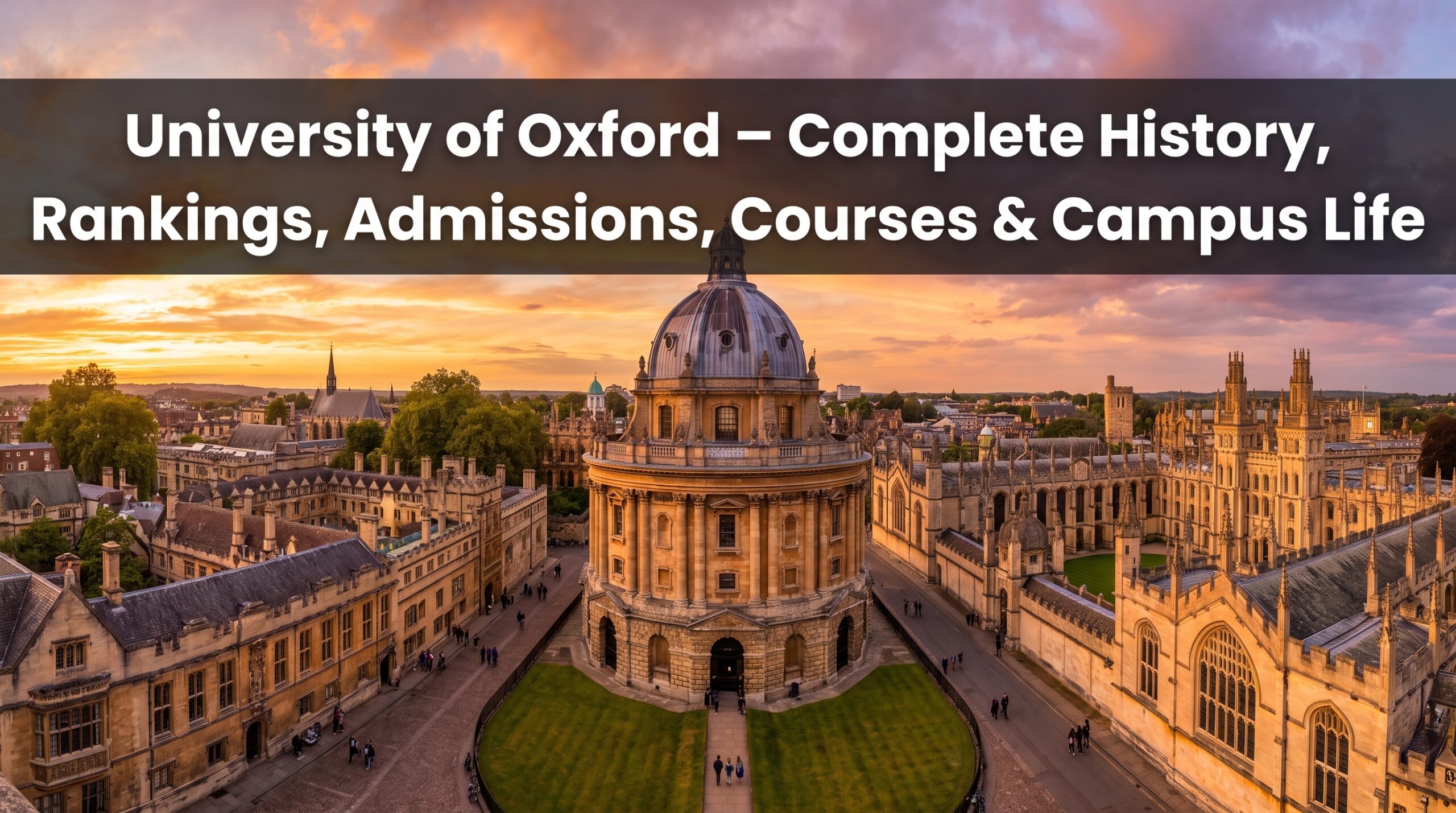
The University of Oxford is a living monument to human intellectual endurance. As the oldest university in the English-speaking world, its exact foundation date remains lost to the mists of antiquity, though evidence of teaching stretches back astonishingly to 1096. Situated in the historic city of Oxford, Oxfordshire, roughly 60 miles northwest of London, the university is affectionately known as the “City of Dreaming Spires”—a phrase coined by the Victorian poet Matthew Arnold in reference to the sublime, honey-coloured architectural harmony of the university’s buildings. For nearly a millennium, Oxford has served as the intellectual cradle of the British establishment, a colossal academic powerhouse that has shaped the history, politics, and scientific advancements of Western civilization.
As of 2026, the University of Oxford continues to operate at the absolute zenith of global higher education. Under the strategic guidance of Vice-Chancellor Professor Irene Tracey and Chancellor Lord Hague of Richmond, the institution has firmly cemented its modern dominance. The university proudly holds the number one global position in the Times Higher Education (THE) World University Rankings for an unprecedented tenth consecutive year. Oxford is an incredibly complex, decentralized matrix comprising the central university, 39 highly autonomous constituent colleges, and six permanent private halls. From the rigorous, Socratic intensity of the tutorial system to the massive, multi-billion-pound pharmaceutical spin-outs developing in its science parks, Oxford seamlessly bridges the gap between medieval tradition and cutting-edge, 21st-century innovation. This exhaustive profile examines the chaotic history, the impenetrable collegiate structure, the legendary academic rigour, and the timeless traditions of the world’s most enduring academic institution.
Founding and Early Medieval History (11th to 13th Century)
Unlike many modern institutions founded by a single charter or wealthy benefactor, the University of Oxford grew organically, almost accidentally, out of a loose gathering of scholars. While teaching existed in Oxford in some form as early as 1096, the university experienced a massive, rapid expansion in 1167. King Henry II, locked in a bitter political dispute with Thomas Becket and the French Crown, officially banned English students from attending the University of Paris. Forced to return to England, a vast influx of ambitious, intellectually starved scholars descended upon the town of Oxford, transforming it rapidly into a major centre of academic learning.
The early medieval university was a highly volatile environment. Students, heavily protected by ecclesiastical courts, frequently clashed with the local townsfolk, leading to a bitter, centuries-long dynamic known as “town and gown.” The most notorious of these conflicts was the St Scholastica Day riot of 1355. Triggered by a drunken dispute between Oxford students and a local taverner over the quality of wine, the altercation escalated into a horrific three-day battle resulting in the deaths of over 60 scholars and 30 locals. In the aftermath, the English Crown intervened heavily, ruling in favour of the university and granting it sweeping, extraordinary legal privileges over the town, firmly establishing the university’s absolute dominance over the city of Oxford.
The Rise of the Collegiate System
To assert control over the unruly student population, who initially lived in unchaperoned lodging houses across the town, the university began to establish highly structured, enclosed halls of residence. These halls evolved into the collegiate system that defines Oxford today. The exact “first” college is a matter of fierce, ongoing historical debate, but three institutions claim the title of the oldest: University College (which mythological tradition attributes to King Alfred the Great in 872, though practically founded in 1249), Balliol College (founded by John I de Balliol around 1263), and Merton College (established in 1264).
Merton College was uniquely significant because its founder, Walter de Merton, drew up comprehensive statutes detailing the governance of the college, establishing the first true template for the collegiate model that both Oxford and Cambridge would subsequently follow. During this era, Oxford became deeply entwined with the Catholic Church. Monastic orders such as the Dominicans, Franciscans, and Carmelites established significant presences within the university, transforming Oxford into a premier European centre for theological and philosophical debate, producing legendary medieval scholars like John Duns Scotus and William of Ockham.
Renaissance, Reformation, and Civil War
The Renaissance brought the revival of classical Greek and Latin scholarship to Oxford, heavily championed by early humanists such as Desiderius Erasmus, who lectured at the university. However, the subsequent English Reformation in the 16th century violently shattered the university’s medieval Catholic traditions. Following Henry VIII’s break with Rome, Oxford was purged of its Catholic influences, monastic colleges were dissolved, and massive amounts of medieval manuscripts were tragically destroyed. During the reign of Mary I, who briefly restored Catholicism, Oxford became the site of the horrific execution of the “Oxford Martyrs”—Anglican bishops Hugh Latimer, Nicholas Ridley, and Archbishop Thomas Cranmer—who were burned at the stake outside Balliol College, an event still commemorated by the Martyrs’ Memorial today.
In the 17th century, during the English Civil War (1642–1651), Oxford found itself at the absolute centre of national politics. The university was fiercely royalist, and when King Charles I was forced to flee London, he established his royal court and the counter-Parliament directly within the colleges of Oxford. Christ Church served as the King’s personal palace, while the Queen resided in Merton College. Following the eventual victory of the Parliamentarians, Oliver Cromwell, who ironically served as the university’s Chancellor from 1650 to 1657, purged the university of royalist sympathisers, though the institution ultimately survived the political upheaval intact.
The Victorian Era and Modern Transformations
During the 19th century, Oxford underwent profound intellectual and structural transformations. The Oxford Movement (also known as Tractarianism), led by John Henry Newman and John Keble, originated within the university, seeking to restore ancient Catholic traditions within the Church of England, sparking massive national theological debates. Simultaneously, the university was fundamentally modernized through a series of Royal Commissions. The archaic requirement that all fellows (academics) must be unmarried clergymen of the Church of England was finally abolished, opening the university to dissenters and secular scholars.
The late Victorian era also marked a critical, hard-fought victory for gender equality. In 1878, the first academic halls for women were established (Lady Margaret Hall and Somerville College). However, women were not granted full membership to the university and were not permitted to officially receive their degrees until 1920. In 1974, several historic all-male colleges (Brasenose, Jesus, Wadham, Hertford, and St Catherine’s) finally broke centuries of tradition and began admitting women. Today, the student body is heavily balanced, and all constituent colleges are entirely coeducational.
The 2026 Academic Landscape and Governance
As of 2026, the governance of the University of Oxford is highly complex, operating as an entirely self-governing institution. The Chancellor, Lord Hague of Richmond (elected in late 2024), serves as the titular, ceremonial head of the university, a lifetime appointment possessing immense prestige but limited operational power. The true executive authority rests with the Vice-Chancellor. Professor Irene Tracey, an internationally renowned neuroscientist who assumed the role in January 2023, currently leads the institution, heavily focusing her tenure on expanding Oxford’s global research impact, securing massive philanthropic funding, and expanding access for students from socio-economically disadvantaged backgrounds.
The core legislative body of the university is the Congregation, famously dubbed the “parliament of the dons.” Comprising over 5,000 academic and senior administrative staff, the Congregation holds the ultimate authority over all major university policies and statutes. The central university is responsible for organizing core lectures, setting massive, standardized examinations, awarding degrees, and operating the sprawling network of centralized research laboratories and major libraries. However, the true soul of the Oxford experience resides entirely within its independent colleges.
The Collegiate Structure and Key Colleges
To understand Oxford, one must understand the collegiate system. Oxford is not a single, monolithic campus; it is a federation. The university is composed of 39 independent, self-governing colleges and six permanent private halls. Each college possesses its own royal charter, its own massive endowment, its own dining hall, library, chapel, and student bar. The colleges are fiercely independent; they select their own undergraduate students, employ their own tutors, and manage their own vast real estate portfolios.
When an undergraduate applies to Oxford, they belong simultaneously to the central university and to their specific college. The college is where a student lives, eats, socializes, and, most importantly, receives their core tutorial teaching. The culture, wealth, and architecture vary wildly between institutions.
| Notable College | Year Founded | Characteristics & Famous Alumni |
|---|---|---|
| Christ Church | 1546 | The largest and wealthiest college. Famous for its massive Tom Quad and inspiring the Harry Potter Great Hall. Produced 13 British Prime Ministers. |
| Magdalen College | 1458 | Renowned for its breathtaking deer park, massive tower, and riverside walks. Alumni include Oscar Wilde and Seamus Heaney. |
| Balliol College | 1263 | Known for fierce intellectualism, intense political engagement, and a left-leaning reputation. Alumni include Boris Johnson and Adam Smith. |
| Trinity College | 1555 | Famous for its expansive lawns, beautiful blue gates, and strong sporting traditions. |
| All Souls College | 1438 | Unique in that it has zero undergraduate students. It is exclusively for elite, elected academic fellows who pass the “hardest exam in the world.” |
| Oriel College | 1326 | The oldest royal foundation, famously known for its prowess in rowing (Head of the River) and theological history. |
Undergraduate Admissions, The UCAS System, and Interviews
Securing undergraduate admission to the University of Oxford is an intensely competitive, highly structured process. Oxford receives tens of thousands of applications annually for roughly 3,300 undergraduate places, resulting in a highly selective overall acceptance rate hovering around 16% to 17%. Unlike American universities, Oxford’s admissions process is almost entirely blind to extracurricular activities (unless they directly relate to the chosen academic subject) and heavily ignores “legacy” status or athletic prowess. The singular, absolute criterion for admission is sheer academic brilliance and intellectual potential.
The application process begins uncharacteristically early. Prospective students must submit their applications through the UK’s centralized UCAS system by an unyielding deadline of October 15th—months before the standard UK university deadlines. Most subjects mandate that applicants take heavily rigorous, subject-specific aptitude tests (such as the LNAT for Law, the MAT for Mathematics, or the TSA for Social Sciences) in early November. Candidates who achieve the highest scores on these tests, combined with flawless high school academic records, are then invited for the legendary Oxford Interview.
The Oxford Interview is not a standard behavioral evaluation; it is effectively a mock tutorial. Conducted directly by the academic tutors of the colleges in December, the interviews are deliberately designed to push students to the absolute limit of their knowledge and assess how they think, analyze new information, and defend an argument under intense intellectual pressure. Tutors frequently pose seemingly impossible, highly abstract questions to evaluate a candidate’s mental agility rather than their rote memorization.
Graduate Admissions and Advanced Research
While the undergraduate colleges are steeped in ancient tradition, Oxford’s graduate community drives the institution’s modern global research dominance. Over 45% of the total student body consists of postgraduate students pursuing master’s and doctoral degrees. Graduate admissions are evaluated entirely by the central university’s academic departments and faculties, rather than the individual colleges.
Oxford grants the Doctor of Philosophy (DPhil) instead of the standard PhD, reflecting ancient institutional nomenclature. The university is globally renowned for its highly intense, one-year Master of Science (MSc) programs and the prestigious two-year Master of Philosophy (MPhil). In the legal sphere, the Bachelor of Civil Law (BCL)—which, despite its name, is a master’s level degree—is universally considered the most rigorous, highly respected postgraduate law qualification in the English-speaking world. Graduate students at Oxford belong to their college’s Middle Common Room (MCR), which provides a dedicated social and academic hub separate from the undergraduate population.
World Rankings and Global Reputation
The global academic reputation of the University of Oxford is largely unparalleled. The university consistently occupies the absolute pinnacle of global higher education metrics, fiercely competing with Cambridge, MIT, and Harvard for supremacy. Oxford is particularly renowned for its massive output of highly cited research, the global employability of its graduates, and its unparalleled prestige in the humanities and social sciences.
| Ranking Organization (2026/2027 Data) | Global Rank | UK Rank |
|---|---|---|
| Times Higher Education (THE) World Rankings | #1 | #1 |
| QS World University Rankings | #4 | #2 |
| Academic Ranking of World Universities (ARWU) | #6 | #2 |
| U.S. News & World Report Best Global Universities | #4 | #1 |
The Tutorial System and Academic Rigor
The defining, absolute jewel of an Oxford undergraduate education is the Tutorial System. While students attend massive, university-wide lectures and laboratory sessions, the true crucible of learning occurs in the tutorial. Once or twice a week, students meet with a college tutor—who is frequently a world-renowned expert in the field—either one-on-one or in pairs. Prior to the tutorial, the student is expected to read a massive list of primary sources and write a heavily researched, highly analytical essay (typically 2,000 words).
During the hour-long tutorial, the student reads or defends their essay while the tutor systematically dismantles their arguments, interrogates their logic, and forces them to defend their intellectual positions. There is nowhere to hide in a tutorial; if a student has not done the reading or their logic is flawed, it is immediately exposed. This pedagogical method is incredibly expensive and highly resource-intensive to maintain, but it forges graduates with unparalleled critical thinking skills, supreme intellectual confidence, and the ability to rapidly process and debate highly complex information.
Notable Courses and the BA/MA (Oxon) Structure
Oxford does not use the term “major”; students apply directly for a specific “course” (degree) and study that subject almost exclusively from their very first day. The university is famous for several highly unique, historically prestigious degree programmes. The most famous is PPE (Philosophy, Politics and Economics). Created in the 1920s to train the future civil servants of the British Empire, PPE is widely considered the ultimate degree for future politicians, having produced countless Prime Ministers, foreign dignitaries, and global journalists. Other legendary courses include Literae Humaniores (affectionately known as “Greats”), a notoriously punishing degree in Classics (Latin, Ancient Greek, and Ancient Philosophy), and Jurisprudence (Law).
Oxford possesses a highly unique, archaic degree structure. Upon graduation, undergraduate students are awarded a Bachelor of Arts (BA). However, 21 terms (seven years) after their initial matriculation, an Oxford BA graduate is legally permitted to apply to the university to have their degree automatically upgraded to a Master of Arts (MA Oxon), without completing any additional postgraduate study or examinations. This ancient tradition grants them specific voting rights within the university’s governance structures.
Libraries (The Bodleian), Museums, and Archives
The library system at the University of Oxford is the largest academic library system in the United Kingdom. At its absolute core is the legendary Bodleian Library, universally known as “the Bod.” Opened in 1602 by Sir Thomas Bodley, it operates as a legal deposit library, meaning it is legally entitled to request a free copy of every single book published in the United Kingdom and Ireland. Holding over 13 million printed items, its massive underground tunnels connect historic reading rooms, including the breathtaking Duke Humfrey’s Library, a medieval masterpiece featuring chained books and heavily painted ceilings.
Oxford is also home to several of the world’s most significant university museums. The Ashmolean Museum, founded in 1683, holds the title of the oldest public museum in the world, housing massive collections of art, Egyptian mummies, and archaeological artifacts. The Pitt Rivers Museum is a bizarre, fascinating anthropological treasure trove, famous for its dense, Victorian-style displays of shrunken heads, ancient weaponry, and cultural artifacts arranged by typology rather than geography. The Oxford University Museum of Natural History, housed in a stunning neo-Gothic building, hosted the famous 1860 debate on evolutionary theory between Thomas Huxley and Bishop Samuel Wilberforce.
Campus Architecture and Historic Landmarks
Walking through the centre of Oxford is akin to walking through an architectural history book spanning a thousand years. The central university buildings, located around Broad Street and Radcliffe Square, are some of the most photographed structures in Europe. The Radcliffe Camera, a stunning, circular, neo-classical library built in the 18th century, serves as the unofficial, visual symbol of the entire university. Adjacent to it stands the Sheldonian Theatre, an exquisite, D-shaped building designed by Sir Christopher Wren, which serves as the official ceremonial hall for the university.
Other iconic landmarks include the Bridge of Sighs (officially the Hertford Bridge), a highly decorative skyway connecting two parts of Hertford College over New College Lane, heavily resembling its namesake in Venice. Tom Tower, a beautiful bell tower designed by Christopher Wren at the entrance of Christ Church, rings “Great Tom” (the heaviest bell in Oxford) exactly 101 times every night at 9:05 PM—a historic tradition originally signalling the closing of the college gates for the original 101 scholars, operating on “Oxford Time” which is five minutes behind Greenwich Mean Time.
Campus Life, JCR Culture, and Residential Life
Student life at Oxford revolves entirely around the individual colleges. The undergraduate student body of a college is collectively known as the Junior Common Room (JCR). The JCR elects its own president and committee, organizing massive welfare events, sports fixtures, and legendary parties known as “Bops” (Breach of the Peace). Bops are heavily themed, heavily alcohol-fueled, fancy-dress college parties typically held in the college bar or underground cellars.
Dining is a massively important, deeply formalized aspect of college life. Most colleges hold “Formal Hall” multiple times a week. Students are required to wear academic gowns over formal attire and sit at long, candlelit wooden tables. The college’s academic fellows sit at the “High Table” raised on a dais at the end of the hall. The meal is preceded by a Latin grace, read quickly by a scholar, before students enjoy a three-course, highly subsidized meal. This creates an intense, communal atmosphere that binds the students to the ancient rhythms of their specific college.
Oxford Traditions, Sub Fusc, and Ceremonies
Oxford is saturated in bizarre, deeply entrenched traditions that heavily dictate the academic calendar. The most visible of these traditions is the wearing of “Sub Fusc”—formal academic dress consisting of a dark suit or skirt, a white collared shirt, a black ribbon or bowtie, and a black academic gown. Students are strictly mandated to wear Sub Fusc during their official Matriculation ceremony (where they are formally admitted to the university in the Sheldonian Theatre) and, most notably, during every single official university examination.
During the exam season, students wear carnations pinned to their Sub Fusc: a white carnation for their first exam, a pink carnation for intermediate exams, and a red carnation for their final exam. Upon completing their absolute final exam, students exit the massive Examination Schools on High Street and are immediately ambushed by their friends in a tradition known as “Trashing.” They are violently covered in prosecco, shaving foam, confetti, and flour to celebrate the end of their degree, despite heavy university threats of disciplinary action attempting to curb the messy practice.
Athletics, The Boat Race, and The Oxford Union
While Oxford does not offer athletic scholarships, sports (referred to as “Blues” sports) are taken incredibly seriously. Athletes who represent the university against Cambridge at the highest level are awarded a “Blue,” the most prestigious athletic accolade in British university sports. The absolute pinnacle of the sporting calendar is The Boat Race, an annual, brutal rowing race between the Oxford University Boat Club and Cambridge, fought over a 4.2-mile championship course on the River Thames in London, broadcast live to millions of viewers globally.
Outside of athletics, the most powerful and famous extracurricular organization is The Oxford Union. Founded in 1823, it is not the student government (that is the Oxford SU), but rather an independent, fiercely prestigious debating society. The Union operates as a massive proving ground for future politicians, possessing a grand debating chamber designed to mimic the House of Commons. The society is famous for inviting the most controversial, high-profile figures in global politics, entertainment, and science to speak and be fiercely cross-examined by the students.
Innovation Ecosystem, Oxford Science Park, and Spin-Outs
Despite its ancient facade, modern Oxford is a colossal engine of technological and medical innovation. The university is heavily integrated into a massive network of science parks located on the outskirts of the city, most notably the Oxford Science Park and the Begbroke Science Park. Through its highly aggressive technology transfer office, Oxford University Innovation (OUI), the university is the most prolific creator of academic spin-out companies in the United Kingdom, turning laboratory discoveries into massive commercial enterprises.
The university’s capacity for rapid, world-saving innovation was definitively proven during the COVID-19 pandemic. Researchers at the Jenner Institute, partnered with the Oxford Vaccine Group, developed, tested, and partnered with AstraZeneca to manufacture a highly effective, low-cost COVID-19 vaccine that was distributed globally at cost, saving an estimated millions of lives. In 2026, the university continues to lead massive global initiatives in artificial intelligence alignment, quantum computing, and the development of next-generation malaria vaccines.
Financial Standing, Endowment, and Philanthropy
To sustain its tutorial system and massive research apparatus, Oxford relies on profound wealth. However, evaluating Oxford’s finances is highly complex due to the decentralized collegiate system. The central university possesses its own massive endowment, but the 39 independent colleges also possess their own heavily guarded, private endowments, generated from centuries of wealthy alumni donations and massive historic real estate holdings across the United Kingdom.
When the central university endowment is combined with the total assets of the individual colleges, the aggregate wealth of “Oxford” exceeds £6 billion (roughly $7.5 billion USD), making it the wealthiest university system in the United Kingdom, though it still falls short of the massive endowments of American Ivy League institutions like Harvard or Stanford. This wealth is heavily utilized to subsidize the incredibly expensive tutorial teaching system and to provide the Crankstart Scholarship (formerly the Moritz-Heyman scholarship), an incredibly generous financial aid program that provides massive living stipends and fee reductions to UK students from low-income households.
Notable Alumni and Faculty
The alumni network of the University of Oxford—affectionately known as “Old Members”—constitutes the absolute core of the British, and often global, political and cultural establishment. The university has educated a staggering 30 British Prime Ministers, spanning from Sir Robert Peel and William Gladstone to modern figures like Margaret Thatcher, Tony Blair, Boris Johnson, Liz Truss, and Rishi Sunak. The production line of global leaders is immense, having also educated US President Bill Clinton (who attended as a Rhodes Scholar), Indian Prime Minister Indira Gandhi, and Pakistani Prime Minister Benazir Bhutto.
In the realms of literature and science, Oxford’s output is equally mythological. J.R.R. Tolkien, who taught Anglo-Saxon at Pembroke College and English at Merton College, wrote *The Lord of the Rings* while drinking with C.S. Lewis (author of *The Chronicles of Narnia*) at the local Eagle and Child pub. Other legendary literary alumni include Oscar Wilde, Percy Bysshe Shelley, and T.S. Eliot. In the sciences, Oxford was the academic home to theoretical physicist Stephen Hawking (who completed his undergraduate degree at University College), Albert Einstein (who briefly held a research fellowship at Christ Church), and Tim Berners-Lee, the inventor of the World Wide Web.
20 Interesting Facts
- Older than the Aztecs: Teaching at Oxford began as early as 1096, making the university significantly older than the founding of the Aztec Empire (1325).
- The Rhodes Scholarship: Oxford is the home of the Rhodes Scholarship, arguably the most prestigious, fiercely competitive international graduate scholarship in the world.
- The Harry Potter Connection: The majestic Tudor dining hall at Christ Church College served as the direct visual inspiration for the Great Hall in the Harry Potter film series.
- Oxford Time: Oxford technically sits 5 minutes behind Greenwich Mean Time. Consequently, all university lectures and exams officially start 5 minutes past the hour.
- The Word “Snob”: A popular, albeit apocryphal, myth claims the word “snob” originated at Oxford from the Latin sine nobilitate (without nobility) written next to the names of non-aristocratic students.
- Alice in Wonderland: Charles Dodgson, a mathematics tutor at Christ Church, wrote Alice’s Adventures in Wonderland under the pen name Lewis Carroll, inspired by the Dean’s daughter, Alice Liddell.
- A Banned Poet: The romantic poet Percy Bysshe Shelley was famously expelled from University College for writing and distributing a pamphlet titled The Necessity of Atheism.
- The Oxford Comma: The highly debated “Oxford Comma” (the final comma in a list of things before ‘and’ or ‘or’) was historically mandated by the Oxford University Press styling guide.
- No Central Campus: There is no physical boundary or walls marking the “University of Oxford.” The colleges and departments are seamlessly integrated directly into the fabric of the city.
- A Tortoise Race: Corpus Christi College and Oriel College hold an annual, incredibly slow Tortoise Race, where college pet tortoises “race” to the edge of a circle of lettuce.
- The Eagle and Child: A legendary Oxford pub (currently undergoing renovations) where the “Inklings,” a literary group including J.R.R. Tolkien and C.S. Lewis, met weekly to discuss their fantasy novels.
- A Prime Ministerial Factory: An astonishing 30 British Prime Ministers have been educated at Oxford, the vast majority of them studying PPE or Classics.
- The Encaenia: An ancient, highly formal annual ceremony held in the Sheldonian Theatre where the university awards honorary degrees to distinguished global figures.
- The Ashmolean Museum: Opened in 1683, the Ashmolean was the very first university museum in the world and the first public museum in Britain.
- Sub Fusc Mandate: The university administration once held a student referendum on whether to abolish the archaic, uncomfortable Sub Fusc exam attire. The students voted overwhelmingly to keep it.
- The Radcliffe Camera: The iconic circular building is not a camera in the photographic sense; “camera” is simply the Latin word for room or chamber. It serves as a massive reading room for the Bodleian Library.
- Punting on the Cherwell: A massive summer tradition where students rent flat-bottomed wooden boats (punts) and propel themselves along the River Cherwell using a long metal pole.
- Pennying: A historic, banned drinking game during college formal dinners where a student secretly drops a penny into another student’s wine glass, forcing them to finish the drink to “save the Queen from drowning.”
- Stephen Hawking’s Laziness: Stephen Hawking famously estimated that he only studied about 1,000 hours during his entire three-year undergraduate degree at Oxford (roughly one hour a day), yet he still graduated with a First Class degree.
- Inspector Morse: The city and the university colleges serve as the iconic, moody backdrop for the incredibly famous British detective series Inspector Morse, Lewis, and Endeavour.
FAQ